When patients describe the smile they want, "natural-looking" comes up more than almost anything else. They've seen veneers that look too bright, too square, too long, too thick, or somehow just off — and they don't want that.
It's a completely valid concern. And the answer to it isn't about toning down your results. It's about understanding what "natural" actually requires — technically and artistically.
What Makes a Veneer Look Natural
Natural teeth are not flat white objects. They have depth, variation, and texture.
Look closely at your own teeth and you'll notice different shades across a single tooth — slightly translucent at the tip, more opaque toward the gum. There are subtle surface ridges, a gentle sheen, and differences from one tooth to the next.
That complexity is what makes a smile look like a smile, and not a set of ceramic tiles.
A veneer that doesn't replicate this looks fake — usually because it's too uniform, too opaque, or too bright relative to the rest of the face. Getting it right means considering material, design, and the relationship between your teeth and your overall facial features.
The Role of Material
The material your veneers are made from determines how light behaves when it hits them.
Natural enamel is semi-translucent — light passes partway into the tooth before reflecting back. This gives teeth their characteristic depth. A high-quality porcelain veneer, particularly feldspathic porcelain, replicates this by allowing light to pass through its outer layers before reflecting from deeper within.
This property — translucency — is what separates a veneer that blends into your smile from one that sits on top of it.
At Drs. Nicolas & Asp Centers, we work with world-class ceramics including Emax (lithium disilicate) and hand-layered feldspathic porcelain. Each has specific optical advantages:
- Feldspathic porcelain offers exceptional translucency and a glass-like quality that closely mimics natural enamel. It is ideal for front teeth where aesthetic demands are highest.
- Emax (lithium disilicate) combines excellent strength with lifelike translucency, making it a reliable choice when both durability and aesthetics are priorities.
Composite veneers, sculpted directly onto your teeth in a single visit, can also be made to look very natural in skilled hands — though they typically offer less translucency depth than laboratory-crafted porcelain restorations. Your cosmetic dentist will discuss which material best suits your goals and dental anatomy.
Why Smile Design Matters More Than Shade
Most patients arrive with a shade in mind. But shade is only one variable. The more important question is: how do your teeth fit your face.
Natural-looking veneers are designed around:
- Facial symmetry — your midline, the width of your smile, and the balance between upper and lower lips
- Tooth proportions — the relationship between width and height for each tooth (the ideal width-to-height ratio for a central incisor is generally around 78%, though this varies by individual anatomy)
- Gum line harmony — an uneven gum line around otherwise perfect veneers will always look off
- Skin tone — very bright whites can look jarring against certain complexions; the right shade should complement, not compete
- Age — enamel naturally becomes slightly less translucent and slightly darker over time; a veneer that looks natural at 30 should account for the patient in front of you, not a generic template
This is where artistic judgment and clinical planning converge. Choosing the right shade from a sample card is easy. Knowing which shade will look right on that specific patient, in that specific light, with that specific face — that requires experience.
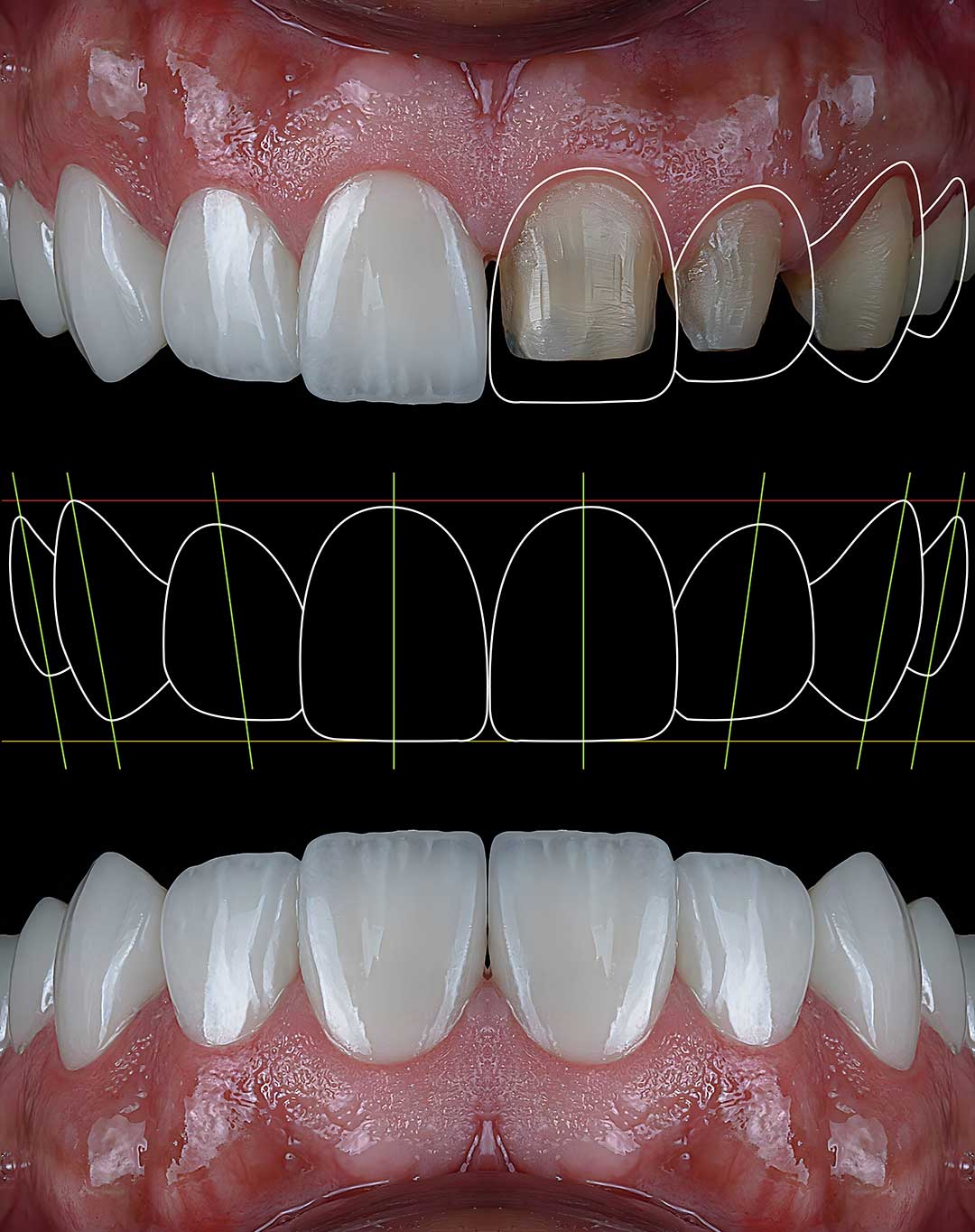
Digital Smile Design (DSD) allows us to plan veneers with precision—mapping proportions, symmetry, and alignment before treatment begins to ensure a predictable, natural result.
How We Plan Veneers at Drs. Nicolas & Asp Centers
At Drs. Nicolas & Asp Centers, every veneer treatment begins with a thorough consultation that goes well beyond selecting a colour.
We use digital smile design technology to plan your result before any preparation begins. This allows you to preview your new smile — and raise any concerns — before treatment starts. There are no surprises.
Digital scanning replaces traditional impressions, giving our in-house laboratory precise 3D data to work from. Our lab team crafts restorations using the same high-level ceramics used internationally, with full control over layering, shade, and surface texture.
We also take a deliberately conservative approach to preparation. Wherever possible, we remove the minimum amount of enamel necessary to place a well-fitting veneer. This protects your natural tooth structure for the long term — which matters, because porcelain laminate veneers have an estimated 10-year survival rate of 95.5%, according to a systematic review published in the Journal of Clinical Medicine in 2021, making them a long-term investment worth protecting.
Throughout the planning process, our cosmetic dentists and Specialist Prosthodontists review every case with one question guiding every decision: does this look like it belongs in this patient's mouth?
That, ultimately, is what "natural-looking" means.
If you're considering veneers in Dubai and want to understand what's involved before committing to anything, we'd encourage you to book a consultation first. Our team will assess your teeth, discuss your goals honestly, and show you what's possible before any treatment is proposed.
Call us at 04 394 7777 or book an appointment online.
Caring for Your Veneers
Porcelain veneers require the same daily care as natural teeth — but a few habits make a meaningful difference in how long they look their best.
- Brush twice daily with a non-abrasive toothpaste and a soft-bristled toothbrush
- Floss daily to keep gum tissue healthy around the veneer margins
- Schedule routine dental checkups so your dentist can monitor veneer margins, bite, and the health of the underlying teeth
- Attend regular hygiene and GBT appointments — your dental hygienist will clean around your veneers to keep them in optimal condition
- If you grind your teeth, wear a custom night guard — bruxism is the most common cause of veneer damage
- Avoid biting hard objects (ice, pen lids, fingernails) with your veneered teeth
Most patients find veneers straightforward to maintain. With consistent care, they can last well over a decade.
Frequently Asked Questions
Yes. Shade matching for partial veneer cases — where only a few teeth are being treated — requires careful attention to the translucency, texture, and colour gradient of the surrounding teeth. This is a technically demanding part of the process and one our ceramists take seriously. In some cases, we may recommend whitening your natural teeth first so the final shade can be matched at a level you're happy with long-term.
Only if they're poorly planned or the wrong shade is selected. Well-designed veneers — using high-translucency ceramics and a shade chosen in context — should not draw attention to themselves. The goal is a smile that looks like it's always been yours.
Traditional veneers require a small amount of enamel to be removed, usually 0.2–0.5mm, roughly the thickness of a contact lens, to create a natural fit and contour. In some cases, ultra-thin or no-prep options may be appropriate, though this depends entirely on your anatomy and goals. Your dentist will explain which approach is right for you and why.
Porcelain veneers are a durable long-term restoration. Clinical research indicates a 10-year survival rate of approximately 95.5%. With proper home care, regular dental visits, and protection against grinding, many patients keep their veneers looking excellent for 15 years or more.
These aren't mutually exclusive — but the distinction is in the design intent. A Hollywood smile traditionally describes a uniformly bright, harmonious, full transformation across all visible teeth. Natural-looking veneers can achieve a dramatic improvement while still being designed to suit your specific face, colouring, and anatomy rather than a generic aesthetic ideal. The two approaches use the same materials; the difference is in how they're planned. You can read more about smile makeovers at Drs. Nicolas & Asp Centers.
At Drs. Nicolas & Asp Centers, we accept most major insurance cards for direct billing of approved treatments and handle all pre-approvals on your behalf. However, dental veneers are a cosmetic procedure and are generally not covered by insurance. We also offer flexible payment options including Tabby (4 interest-free installments) and 0% interest installment plans via partner banks. Full details are available on our Insurance & Payment Options page.