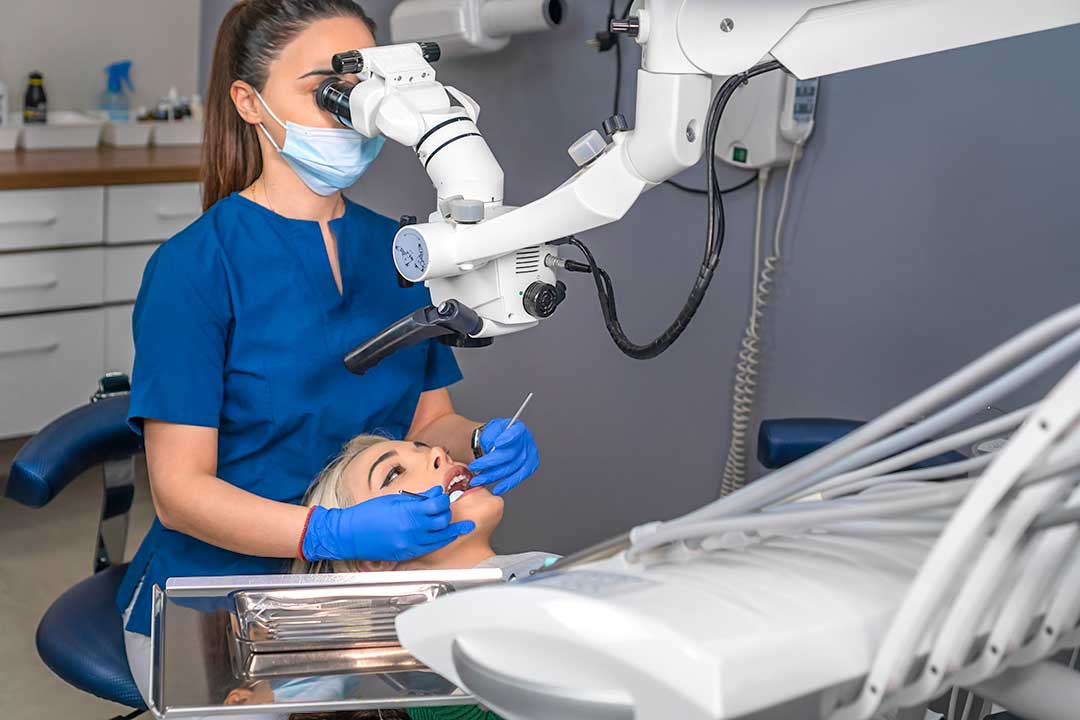
You're at your child's routine dental visit. The dentist pulls up the X-ray, pauses, and says: "There's an extra tooth growing here." Naturally, the questions start immediately.
First — this is more common than you'd think. And it's very manageable when caught early.
What Is a Mesiodens?
A mesiodens is an extra tooth that grows in the upper jaw, right in the middle — between the two front teeth. It's the most common type of extra (supernumerary) tooth, and it shows up in roughly 1 in 50 to 1 in 100 people. Boys get it about twice as often as girls.
Here's the thing: most kids with a mesiodens have no idea it's there. It often sits buried in the gum, never breaking through, quietly causing problems in the background — which is exactly why routine X-rays matter.
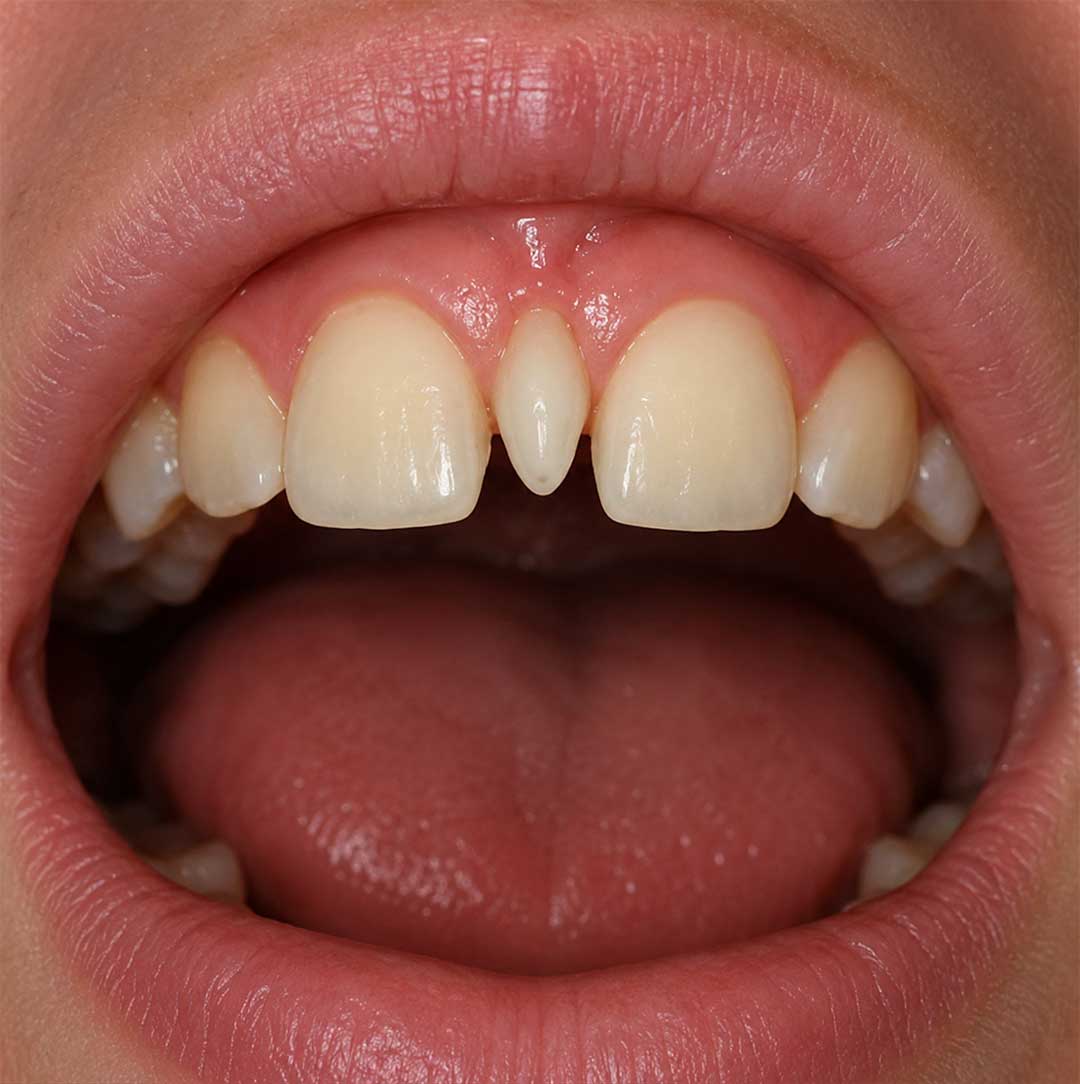
What Does a Mesiodens Look Like?
Usually smaller than a regular tooth. Most are peg-shaped or cone-shaped. Some are barrel-shaped with bumpy cusps. A few look almost like a normal tooth.
What makes it tricky is position — a mesiodens can sit upright, or it can be inverted, meaning the crown points upward toward the nose instead of downward. That detail matters a lot for how and when it gets treated.
Why Does It Happen?
Honestly, it's not fully understood. The leading theory is that the tissue responsible for forming teeth becomes a little overactive during development, producing one extra tooth bud. Genetics play a role too — it can run in families.
In most cases it happens on its own, with no underlying condition. In rarer situations it can be associated with syndromes like cleft lip and palate, but that's not the typical picture.
What Problems Can It Cause If You Leave It?
This is the part parents need to pay attention to. A mesiodens that isn't dealt with can cause a surprising amount of disruption:
- The extra tooth physically blocks the permanent front teeth from coming in — which is often how parents first notice something is off
- It can push the front teeth apart, creating a gap in the middle
- It can rotate or push the permanent teeth out of their normal position
- It can damage the roots of the teeth next to it
- If left buried long enough, it can develop a cyst around it — a fluid-filled sac that damages the surrounding bone
No symptoms right now doesn't mean no problem. These complications can develop quietly while your child's smile is still forming.
How Do Dentists Find It?
An X-ray. You won't see a buried mesiodens with a clinical examination alone. A standard dental X-ray is usually enough to detect it. If surgery is being planned, a CBCT scan — a 3D X-ray — may be recommended to pinpoint exactly where the tooth is sitting before any procedure. This is a good reminder that skipping your child's dental X-rays isn't just about cavities.
How Is a Mesiodens Treated?
In most cases, it needs to come out. Here's how that typically unfolds:
- Earlier removal generally means fewer complications and less likelihood of needing orthodontic treatment afterward
- If the mesiodens is inverted, waiting isn't ideal — inverted teeth can drift deeper into the jaw over time, making the procedure more involved
- After extraction, the dentist checks back at six months to see if the blocked front tooth is now coming in on its own
- If it still hasn't come through after six to twelve months, a minor procedure to expose the tooth may be needed, followed by braces to guide it into place
- Adults who find out about a mesiodens late — even without symptoms — are still usually advised to have it removed to prevent future cyst formation
At Drs. Nicolas & Asp Centers, children with mesiodens are seen by our Specialist Pediatric Dentists. When surgical removal is needed, our Oral & Maxillofacial Surgery team works alongside the pediatric team. If orthodontic follow-up is required, that care continues with our orthodontics team.
To book a consultation, contact our reception team on 04 394 7777 or visit our Appointment page.
Does My Child Need Braces Afterward?
Not automatically. Research shows that many permanently blocked teeth erupt on their own after the mesiodens is removed — particularly when the procedure is done early and there is adequate space."
But if the front teeth have been pushed significantly out of position, or if there's crowding from the delayed eruption, orthodontic treatment is usually part of the picture. An assessment after the extraction will clarify what's needed.
Frequently Asked Questions
Possibly, yes. A mesiodens is one of the more common reasons a permanent front tooth is delayed or blocked. If a front tooth is noticeably late — or if one side has come in but the other hasn't — it's worth getting an X-ray to check what's going on underneath.
No. It won't dissolve or disappear. An untreated mesiodens stays in the jaw, and over time, even a quiet one carries the risk of cyst formation. The decision is really about when to treat it, not whether to.
It depends on the child's age, the position of the tooth, and how cooperative the child is likely to be. Depending on the assessment, conscious sedation or general anesthesia may be recommended. The specialist will advise on the most appropriate approach. Visit our General Anesthesia for Children page for more information.
Given that treatment usually involves surgery, specialist imaging, and possible follow-up orthodontics, specialist involvement is the right call. At Drs. Nicolas & Asp Centers, children are seen by Specialist Pediatric Dentists, with the oral surgery and orthodontics teams brought in as needed.
It depends on your plan and the specific treatment involved. At Drs. Nicolas & Asp Centers, we accept most major insurance cards for direct billing and take care of all pre-approvals and paperwork for you. Visit Insurance & Payment Options for more information.
- American Academy of Pediatric Dentistry. "Management of the Developing Dentition and Occlusion in Pediatric Dentistry." The Reference Manual of Pediatric Dentistry. American Academy of Pediatric Dentistry, 2025–2026, pp. 497–515. Latest revision 2024. aapd.org
- Russell, Kathleen A., and Magdalena A. Folwarczna. "Mesiodens: Diagnosis and Management of a Common Supernumerary Tooth." Journal of the Canadian Dental Association, vol. 69, no. 6, 2003, pp. 362–366. pubmed.ncbi.nlm.nih.gov
- Meighani, G., and A. Pakdaman. "Diagnosis and Management of Supernumerary (Mesiodens): A Review of the Literature." Journal of Dentistry (Tehran), vol. 7, no. 1, 2010, pp. 41–49. pmc.ncbi.nlm.nih.gov
- Shih, Wen-Yu, Chun-Yi Hsieh, and Tzong-Ping Tsai. "Clinical Evaluation of the Timing of Mesiodens Removal." Journal of the Chinese Medical Association, vol. 79, no. 6, 2016, pp. 345–350. pubmed.ncbi.nlm.nih.gov
- Panyarat, C., et al. "Rare Genetic Variants in Human APC Are Implicated in Mesiodens and Isolated Supernumerary Teeth." International Journal of Molecular Sciences, vol. 24, no. 5, 2023, p. 4255. doi.org