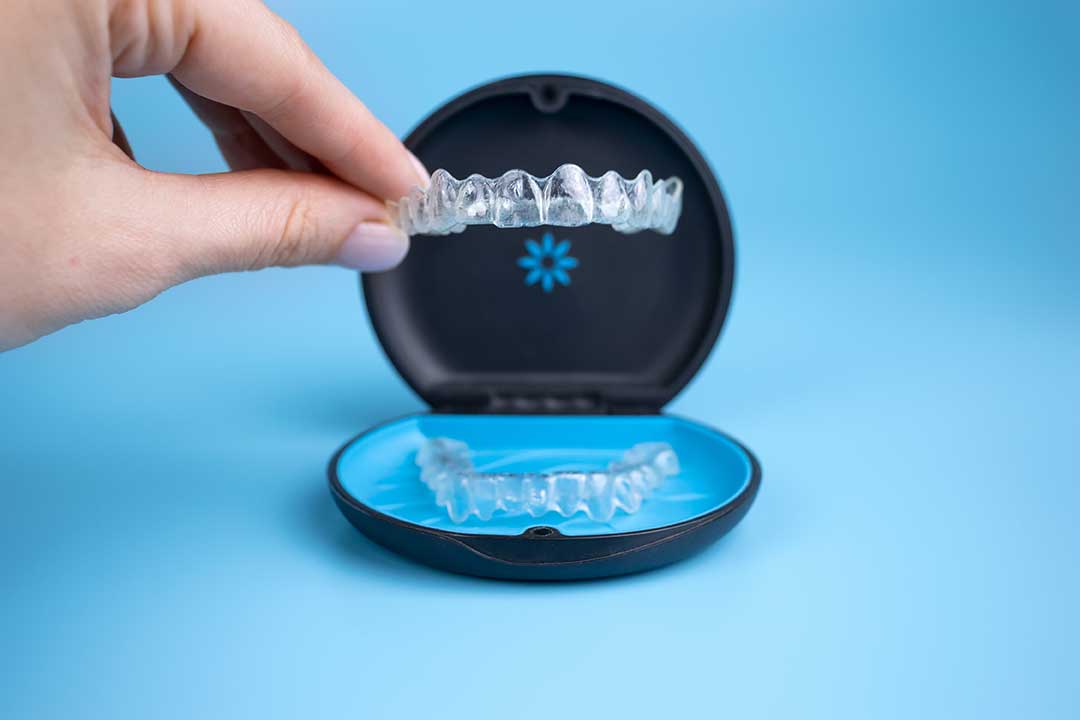
You've had a crown placed on one of your teeth, and now you're wondering whether that rules out Invisalign.
The simple answer is no — it doesn't.
Having a crown is not a barrier to Invisalign treatment in most cases. But it does affect how your Specialist Orthodontist plans your treatment — specifically around the small attachments that help aligners do their job.
Here's what you need to know.
What Is a Dental Crown?
A dental crown is a custom-made cap placed over a damaged, weakened, or heavily restored tooth. It sits on top of the natural tooth structure and root, restoring the tooth's shape, strength, and appearance.
Crowns are made from different materials — porcelain, ceramic, zirconia, or metal — and the material your crown is made from matters when it comes to Invisalign.
Can Invisalign Move a Crowned Tooth?
Yes — in most cases, a crowned tooth can be moved with Invisalign.
The reason is straightforward. A crown covers the visible part of the tooth, but the root and the periodontal ligament — the tissue connecting the root to the jawbone — remain intact beneath it. Orthodontic movement works through that ligament. Research and clinical experience confirm that crowned teeth respond to orthodontic force in the same way natural teeth do, provided the crown is stable and in good health.
Where the crown becomes a factor is with attachments.
Invisalign uses small, tooth-colored dots of composite resin bonded to certain teeth — called attachments — to help the aligner apply precise force and grip. An experienced Specialist Orthodontist knows exactly how to work with crowned teeth, and will select the right bonding approach for your crown material as part of your treatment plan.
How Does Crown Material Affect Your Treatment
Not all crowns behave the same way when it comes to bonding attachments. The required surface preparation protocol varies by material, and each carries its own considerations.
- Porcelain and ceramic crowns can accept composite attachments after appropriate surface treatment — typically a combination of mechanical roughening and chemical priming. Bond strength is achievable, though it is lower than on natural enamel.
- Zirconia crowns are now among the most widely placed in adults and present the most specific bonding requirements. Zirconia does not respond to the same etching techniques used on conventional porcelain, and a dedicated primer protocol is needed to achieve adequate bond strength. Your Specialist Orthodontist will account for this in the treatment plan.
- Metal crowns also require a specific bonding approach, as standard composite adhesives do not adhere reliably to metal surfaces without specialist surface preparation.
In all cases, knowing the exact material of your crown before treatment begins is important. If you are not certain, your dental records or the clinic that placed it should have this on file.
What Happens to the Crown After Treatment
In some cases, a crown placed before orthodontic treatment may need to be updated once alignment is complete.
If your teeth have moved significantly, the fit, bite, or aesthetics of the crown — designed for your teeth in their previous position — may no longer be optimal. Your Specialist Orthodontist will advise whether any restoration updates are needed, and your dentist or Specialist Prosthodontist will carry out that work. The timing is usually planned for after your teeth have reached their final position.
One other practical point: if your crown is old, loose, or showing signs of wear, it is worth having it assessed before starting Invisalign. A crown in poor condition can complicate attachment bonding and affect how predictably the tooth moves during treatment.
If you'd like a specialist's view on your specific situation before committing to treatment, our second dental opinion service is available at all of our dental clinics in Dubai.
Ready to find out whether Invisalign is right for you?
Our Specialist Orthodontists at Drs. Nicolas & Asp Centers see patients with crowns and complex dental histories regularly. The right starting point is a proper assessment.
Book your consultation at our Jumeirah, Marina Walk, Springs Souk, or Uptown Mirdif centers, or call us on 04 394 7777.
Frequently Asked Questions
Yes, in most cases. Composite attachments can be applied to crown surfaces, but the process is more technically demanding than bonding to natural enamel and the required approach varies by crown material. Porcelain and ceramic crowns, zirconia, and metal each need different surface preparation. Your Specialist Orthodontist will assess your crown material during your consultation and plan accordingly.
Sometimes. If your crown was placed when your teeth were in a different position, the fit, bite, or appearance of that restoration may need to be updated once alignment is complete. Your orthodontist and dentist or Specialist Prosthodontist will coordinate on timing so that any restoration work is finalized after your teeth have settled into their new positions.
Having a crown does not affect your orthodontic insurance coverage. Coverage for Invisalign varies depending on your individual plan. At Drs. Nicolas & Asp Centers, we accept most major insurance cards for direct billing and handle all pre-approvals and paperwork on your behalf. Visit Insurance & Payment Options or call us at 04 394 7777 and we will be more than happy to check your coverage for you.
- Burns, Angus, Annie Hughes, and Michael O'Sullivan. "Orthodontic Bonding in Special Circumstances." British Dental Journal, vol. 237, no. 5, 2024, pp. 400–406. nature.com
- Mehta, S., et al. "Bonding of Metal Orthodontic Attachments to Sandblasted Porcelain and Zirconia Surfaces." BioMed Research International, 2016. hindawi.com
- Nitasnoraset, Kasidit, et al. "Shear Bond Strength of Clear Aligner Attachment Using 4-META/MMA-TBB Resin Cement on Glazed Monolithic Zirconia." Polymers, vol. 16, no. 14, 2024. ncbi.nlm.nih.gov